Power Management
100 KVA Generator Hire: Sizing Guide for Business
Planning a 100 kva generator hire or larger power setup? Learn how to calculate connected load across 45 to 1250 kva systems for commercial sites.
By BorrowBox ·
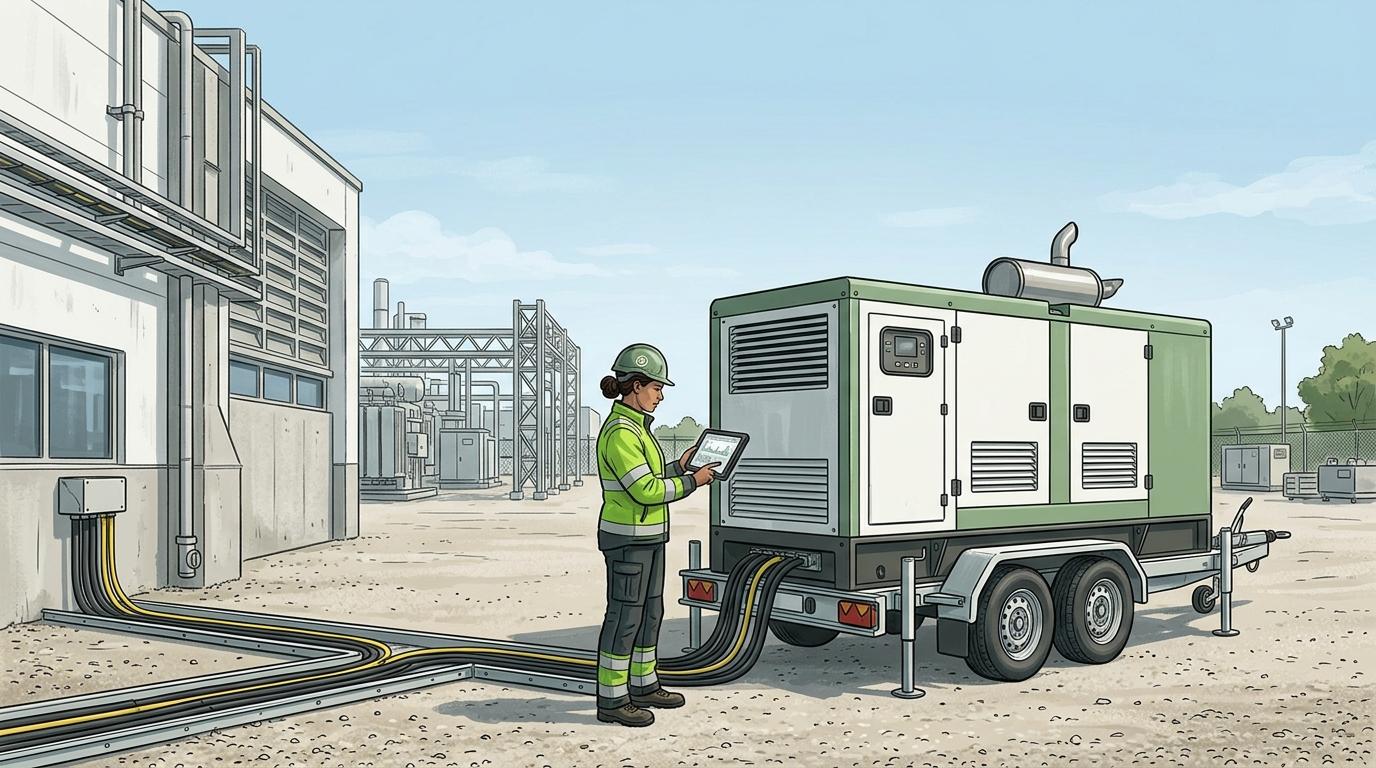
Selecting the correct generator capacity requires balancing total continuous wattage, motor starting surges, and safe operating margins. When evaluating a 100 kva generator hire or planning a larger temporary deployment, the initial calculation converts your active power demand in kilowatts to apparent power in kilovolt amperes using a standard commercial power factor of 0.8. Sizing your electrical plant accurately ensures heavy machinery starts without causing voltage drops, protects sensitive electronics from harmonic distortions, and avoids the heavy fuel penalties of underloaded diesel engines.
Calculating Connected Load from Kilowatts to Kilovolt Amperes
Commercial utility meters and appliance labels usually list power consumption in kilowatts, which measures real work. Generators, however, are rated in kilovolt amperes, representing the total apparent power the alternator must supply. The standard power factor for three phase commercial alternating current systems in India is 0.8 lagging. To convert your active demand into apparent demand, divide your total kilowatt sum by 0.8.
For example, if your office facility or manufacturing floor requires 80 kilowatts of real power during regular operations, dividing 80 by 0.8 yields exactly 100 kilovolt amperes. Running a generator at one hundred percent continuous load accelerates mechanical wear and leaves zero reserve for unexpected spikes. Most mechanical engineers recommend maintaining a steady running load between seventy percent and eighty percent of prime capacity, meaning an 80 kilowatt active load is best supported by a 125 kva or 150 kva system.
- Sum all base lighting, computing, and electronic device ratings in kilowatts
- Identify all inductive loads such as induction motors, air compressors, and chillers
- Apply the power factor formula where apparent power equals real power divided by 0.8
- Incorporate a diversity factor to account for equipment that operates intermittently
- Add a minimum twenty percent headroom cushion for long term mechanical longevity
Managing Inrush Currents and Inductive Motor Surges
Resistive equipment like heaters and lighting draws the exact same current during startup as during standard operation. In contrast, inductive equipment with electric coils draws a significant initial surge known as inrush current. Commercial air conditioners, submersible pumps, concrete mixers, and workshop compressors can draw three to six times their steady state full load current when starting direct on line.
If a construction site operates two 15 kilowatt tower pumps without soft starters, their simultaneous ignition can instantly overwhelm an undersized generator alternator. This causes immediate voltage dips, tripping circuit breakers and potentially damaging microprocessor controls across other site tools. Installing variable frequency drives or soft starters reduces this surge, allowing project teams to hire a smaller, more affordable generator.
Generator Capacity Guide from 45 to 1250 KVA
Generator rentals generally fall into discrete rating tiers. The following overview outlines standard deployment bands, safe continuous loads, and recommended business settings.
| Capacity Band | Continuous Safe Load | Target Business Applications | Engineering Considerations |
|---|---|---|---|
| 45 to 80 KVA | 36 kW to 64 kW | Retail shops, bank branches, small clinics, educational laboratories | Best suited for dominant resistive loads with small individual air conditioning compressors |
| 100 to 250 KVA | 80 kW to 200 kW | Commercial construction sites, hotels, midsize factories, cold rooms | Handles passenger lifts, welding gear, and industrial packaging lines with step start routines |
| 320 to 600 KVA | 256 kW to 480 kW | Hospitals, large shopping complexes, infrastructure works, data hubs | Requires careful feeder balancing across phases to avoid neutral overheating |
| 750 to 1250 KVA | 600 kW to 1000 kW | Heavy industrial plants, automotive assembly, massive events, mining | Often configured in parallel sync setups to scale supply with changing daily shifts |
Operational Penalties of Oversizing Versus Undersizing
Undersizing a temporary generator causes immediate disruption. High current demands cause thermal overloads, frequent nuisance trips, voltage drops that stall pumps, and alternator overheating. The natural reaction for some facility managers is to hire a massive generator to eliminate capacity doubts, but extreme oversizing introduces its own operational hazards.
Running a diesel engine below thirty percent of its rated capacity creates wet stacking. Cylinder combustion temperatures remain too low to burn fuel completely, causing unburnt diesel and soot to accumulate inside exhaust manifolds. Wet stacking degrades fuel economy, increases atmospheric emissions, ruins exhaust valves, and can void service agreements. Correct sizing preserves engine reliability and lowers daily operational expenses.
Monitoring real operating patterns through digital telemetry provides definitive proof of whether your plant operates within ideal thermal bands. BorrowBox integrates real time sensor monitoring on rental fleets to help operations teams verify their true load profiles and adjust capacity.
Frequently Asked Questions About Generator Sizing
What is the primary difference between KW and KVA?
Kilowatts quantify the actual electrical energy converted into mechanical or thermal work. Kilovolt amperes represent apparent power, which accounts for both productive work and inductive energy wasted in magnetic fields across motors and transformers.
How much continuous load can a 100 KVA generator handle?
At a standard 0.8 power factor, a 100 kva machine produces a maximum rating of 80 kilowatts. For stable prime power operation over long shifts, maintaining a continuous load between 60 kilowatts and 65 kilowatts protects internal engine components.
What does diversity factor mean during a site load calculation?
Diversity factor accounts for the operational probability that not all connected equipment runs at peak power simultaneously. Applying this calculation prevents businesses from paying to hire excess standby capacity that remains idle.
Can a soft starter reduce the required generator capacity?
Yes. Soft starters and variable frequency drives limit the massive inrush current drawn by electric motors during ignition. Smoothing this starting spike allows facility managers to rent a smaller generator unit safely.
Why is running a generator on very low load harmful?
Running below thirty percent capacity prevents diesel engines from reaching their normal operating temperature. This causes wet stacking, carbon build up on exhaust valves, crankcase oil dilution, excessive smoke, and elevated fuel wastage.
How do ambient heat and site altitude impact generator output?
Thinner air at high elevations and intense ambient summer temperatures decrease engine oxygen intake, causing thermal deration. Facilities operating above one thousand meters or in extreme heat must factor in a three to ten percent output reduction.
Speak with an electrical specialist to evaluate your connected equipment and obtain the ideal capacity match. Request an expert generator sizing quote